
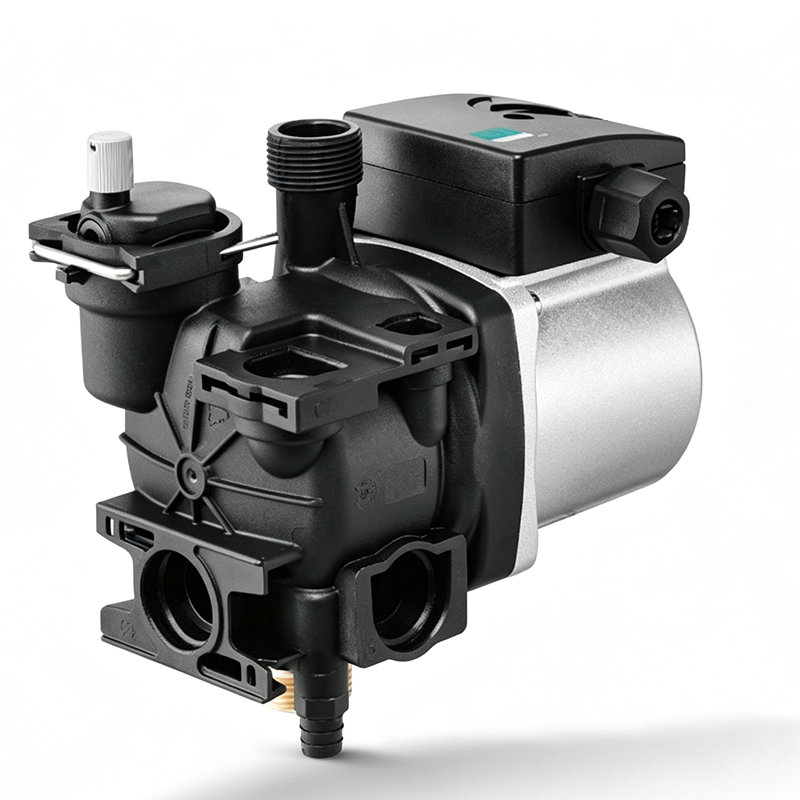
Product Overview
WHEA SERIES pumps are specially designed for gas‑fired (electric) wall‑hung boiler heating systems. The pump supports three‑speed operation.
Within the circulation pipeline of a heating system, circulating water naturally decomposes to generate oxygen, nitrogen and other gases during heating and repeated cycling. These gases accelerate corrosion of system pipelines. Gas blockages will reduce heating efficiency, cause substantial energy waste, trigger vortex effects inside the circulating pump, and result in excessive operating noise. In severe cases, the pump may run dry and burn out.
The WHEA SERIES pump is equipped with a built‑in automatic air vent. It rapidly discharges gases trapped in pipeline fluid. Meanwhile, when negative pressure occurs in the system, the water level inside the air‑vent chamber drops and the valve opens. Ambient air enters the system through the vent port, preventing damage caused by negative pressure.
| S/N | Model | Power (W) | Max.Flow (m³/h) | Max.Head (m) | Outlet OD (mm) | Inlet OD (mm) |
|---|---|---|---|---|---|---|
| 01 | WHEA 15‑50 UC | 90 | 35 | 5 | 20 | 24 |
| 02 | WHEA 15‑60 UC | 100 | 36 | 6 | 20 | 24 |
| 03 | WHEA 15‑70 UC | 120 | 40 | 7 | 20 | 24 |
| 04 | WHEA 20‑50 PCN | 90 | 36 | 5 | 32 | 24.5 |
| 05 | WHEA 20‑60 PCN | 100 | 38 | 6 | 32 | 24.5 |
| 06 | WHEA 20‑70 PCN | 120 | 40 | 7 | 32 | 24.5 |
| 07 | WHEA 15‑50 PCNI | 90 | 36 | 5 | 25 | 24 |
| 08 | WHEA 15‑60 PCNI | 100 | 38 | 6 | 25 | 24 |
| 09 | WHEA 15‑70 PCNI | 120 | 40 | 7 | 25 | 24 |
Product Features
- Integrated automatic air vent to solve air‑lock issues in heating systems Equipped with an integrated automatic air vent, the pump rapidly discharges entrained air inside heating circulating water. When heating systems go through repeated heating cycles, oxygen, nitrogen and other gases are released. Accumulated gas easily causes air blockage. This pump automatically releases pipeline gas. Meanwhile, when negative pressure builds up in the system, the air vent admits ambient air to prevent pipeline damage and pump dry‑running caused by negative pressure.
- Three‑speed adjustment to match varying heating loads The motor supports three‑speed regulation. Users may select speed levels according to house area and heating circuit quantity. Low‑speed mode delivers quieter operation and lower power consumption. High‑speed mode provides higher flow rate for complex pipeline layouts, balancing heating performance and energy consumption flexibly.
- Optimized design for wall‑hung boilers Specially engineered for gas‑fired / electric wall‑hung boiler heating systems. Compact footprint for direct installation with wall‑hung boilers. Its internal flow path is designed for closed‑loop heating hot‑water circulation, and it is NOT intended for cold‑water water‑supply applications.
- Enhanced reliability and fewer system failures Reduced trapped gas mitigates internal pipeline corrosion. It suppresses vortex noise triggered by gas bubbles. It effectively prevents insufficient heating performance and high energy waste caused by air locks, and avoids pump burnout resulting from dry‑run abrasion.
- Durable motor with low noise Adopts canned circulating motor with low vibration and quiet running. The rotor is cooled by the process medium. It is built for long‑term intermittent cyclic operation under typical heating‑system water‑temperature conditions.
Application Scenarios
- Gas‑fired wall‑hung boiler heating systems Primary use case: floor heating and radiator heating for residential gas‑fired wall‑hung boilers. The built‑in vent continuously eliminates trapped air inside heating water circuits.
- Electric wall‑hung boiler heating systems Matches electric wall‑hung boilers for closed hot‑water heating loops in villas and self‑built houses.
- Small‑size closed‑loop hot‑water heating Small‑scale commercial heating and compact radiator systems prone to air locks and uneven radiator heating.
Not suitable for tap‑water pressure boosting, sewage transfer or open water intake applications.
Routine Maintenance
- Initial commissioning & air purging After system water filling, perform initial air exhausting using the integrated pump vent to purge bulk air before long‑term operation. Inspect the air vent regularly for persistent dripping.
- Water‑quality management Use softened clean water for heating circuits to minimize limescale build‑up. Scale deposits may clog the pump chamber and air vent, impairing venting performance and circulation efficiency. Test heating‑loop water periodically and add heating‑system corrosion inhibitor when necessary.
- Noise inspection Listen for operating noise. Bubble crackling or sharp vortex noise indicates excessive trapped air. Check whether the air vent spool is stuck or defective.
- Long‑term idle‑season storage Keep the system fully filled with water when shutting down after heating seasons, to avoid massive air ingress. Implement anti‑freezing protection in low‑temperature environments to prevent pump‑casing cracking from frozen residual water.
- Seal inspection Check for water seepage at pump inlet/outlet connections and air‑vent joints. Aged leaking gaskets draw air continuously into the circuit and cause recurring gas accumulation.
Operating Precautions
- Medium requirements Only circulate hot water within closed heating loops. Never pump sewage, sediment‑laden water, corrosive fluid or use it for tap‑water pressurization. Solid contaminants may jam the air‑vent spool and disable degassing functionality.
- Dry‑running strictly prohibited Never start the pump when the system lacks water. Dry‑running will rapidly damage internal seals and burn out the pump cartridge. Confirm full pipeline water filling before first startup.
- Water‑temperature limits Respect the rated temperature range for boiler heating medium. Excessive temperature accelerates seal aging and causes vent leakage or malfunction.
- Power supply and speed settings Keep supply voltage within rated tolerance. Select appropriate speed setting; avoid long‑duration high‑speed no‑load operation. If thermal protection triggers pump shutdown, cut power and allow natural cooling before fault diagnosis.
- Installation orientation Mount the pump per specification with the air vent facing upward for proper degassing. Incorrect orientation disables air‑release performance.
- Negative‑pressure warning Although the pump includes negative‑pressure balancing capability, avoid sustained system negative‑pressure conditions. Persistent negative pressure draws in ambient air, overloading the air‑vent assembly.
- Selection reminder This is a heating‑dedicated circulating pump for closed hot‑water circuits only. It cannot function as a self‑priming pump or booster pump for raw‑water intake.