
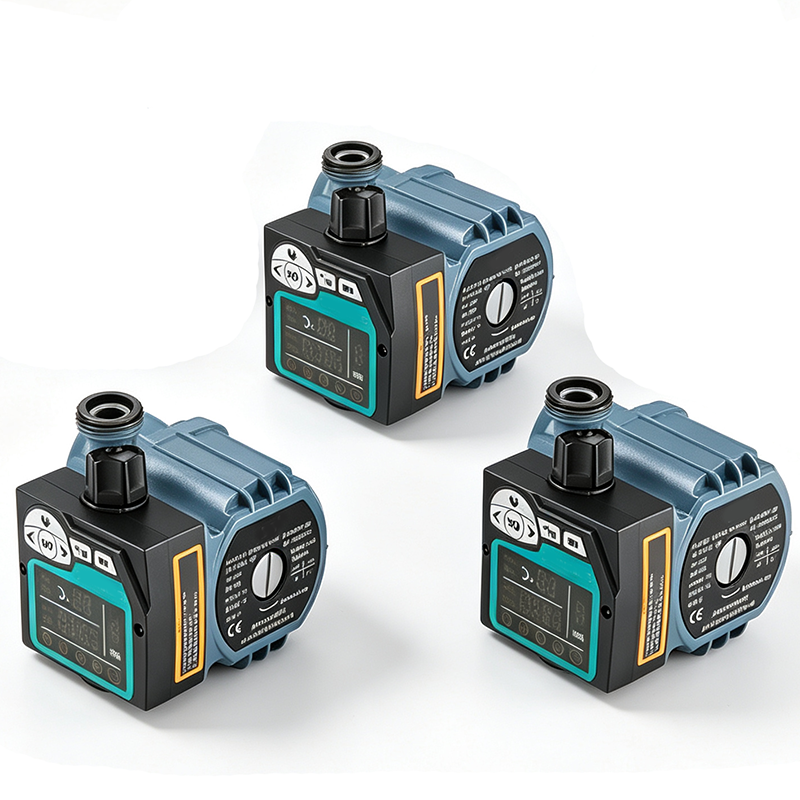
📌Product Application
This electric pump is suitable for underfloor heating automatic control systems, radiator heating, boiler pressurization, household boosting, wall-hung boiler supporting heating, air source heat pump hot water systems, solar engineering supporting and other cold & hot water pressurization circulation systems.
⚙️Operating Conditions
The electric pump can operate continuously under the following conditions:
- The medium to be conveyed is clean water free of solid particles and fibers, with a pH value ranging from 6.5 to 8.5;
- Voltage fluctuation range: -10% ~ +6%;
- Ambient temperature: 2~40°C; medium temperature: 2~110°C (subject to specific model);
- Maximum system working pressure: 1.0MPa.
Canned Circulator Pump (hereinafter referred to as the electric pump) includes XPS 3-speed regulating model, ZPS automatic pressure boosting model, XPH timing & temperature setting model, BPS automatic air venting model and APS intelligent variable frequency model, suitable for hot water systems.
XP high-quality high-power model and CPH hot water circulator model adopt canned motors with wet rotor structure, featuring low noise. The pump eliminates the traditional mechanical seal and uses flat gaskets for static sealing with zero leakage.
The pump will not be overloaded across the full head range and is maintenance-free. High-temperature resistant materials are adopted for all internal motor components.
| Type | Model | Max Input Power (W) | Voltage (V) | Rated Flow (m³/h) | Rated Head (m) | Max Head (m) | Max Flow (m³/h) |
|---|---|---|---|---|---|---|---|
| Basic Type | XPS15-4-130 | 60 | 220 | 1.25 | 2 | 4 | 2 |
| Basic Type | XPS15-6-130 | 90 | 220 | 1.25 | 4 | 6 | 2 |
| Basic Type | XPS20-4-130 | 60 | 220 | 1.5 | 2 | 4 | 2.2 |
| Basic Type | XPS20-6-130 | 90 | 220 | 1.5 | 4 | 6 | 2.2 |
| Basic Type | XPS20-12-180 | 245 | 220 | 1.25 | 10 | 12 | 3 |
| Basic Type | XPS25-4-130 | 60 | 220 | 1.5 | 2.2 | 4 | 3 |
| Basic Type | XPS25-6-130 | 90 | 220 | 1.5 | 4.2 | 6 | 3 |
| Basic Type | XPS25-4-180 | 60 | 220 | 1.5 | 2.2 | 4 | 3 |
| Basic Type | XPS25-6-180 | 90 | 220 | 1.5 | 4.2 | 6 | 3 |
| Basic Type | XPS20-8-180 | 200 | 220 | 3.2 | 5.5 | 8 | 5 |
| Basic Type | XPS25-8-180 | 200 | 220 | 3.2 | 5.5 | 8 | 7 |
| Basic Type | XPS25-12-180 | 245 | 220 | 1.25 | 10 | 12 | 3.5 |
| Basic Type | XPS32-4-180 | 60 | 220 | 1.5 | 2.2 | 4 | 3.5 |
| Basic Type | XPS32-6-180 | 90 | 220 | 1.5 | 4.2 | 6 | 3.5 |
| Basic Type | XPS32-8-180 | 245 | 220 | 3.2 | 5.5 | 8 | 10 |
| Basic Type | XP32-12-220 | 500 | 220 | 5 | 8 | 12 | 10 |
| Basic Type | XP32-16-230 | 700 | 220 | 5 | 12.5 | 16 | 11 |
| Basic Type | XP32-18-230 | 1000 | 220 | 5 | 16 | 18 | 12 |
| Basic Type | XP40-9F-250 | 500 | 220 | 8 | 5 | 9 | 14 |
| Basic Type | XP40-12F-250 | 700 | 220 | 8 | 8 | 12 | 14 |
| Basic Type | XP40-16F-250 | 1000 | 220 | 8 | 12.5 | 16 | 15 |
| Basic Type | XP40-18F-250 | 1300 | 220 | 8 | 16 | 18 | 15 |
| Basic Type | XP50-9F-280 | 700 | 220 | 12.5 | 5 | 9 | 18 |
| Basic Type | XP50-12F-280 | 1000 | 220 | 12.5 | 8 | 12 | 22 |
| Basic Type | XP50-16F-280 | 1300 | 220 | 12.5 | 12.5 | 16 | 22 |
| Basic Type | XP65-9F-300 | 1000 | 220 | 20 | 5 | 9 | 30 |
| Basic Type | XP65-12F-300 | 1300 | 220 | 20 | 8 | 12 | 30 |
| Auto Boost Type | ZP15-9-160 | 120 | 220 | 0.5 | 7 | 9 | 1.6 |
| Auto Boost Type | ZPS15-9-140 | 120 | 220 | 0.5 | 7 | 9 | 1.6 |
| Auto Boost Type | ZPS15-9-195 | 120 | 220 | 0.5 | 7 | 9 | 1.6 |
| Auto Boost Type | ZPS20-12-180 | 245 | 220 | 1.25 | 10 | 12 | 3 |
| Special for Wall-hung Boiler | BPS15-5A | 95 | 220 | 1.25 | 3 | 5 | 2 |
| Special for Wall-hung Boiler | BPS15-5B | 95 | 220 | 1.25 | 3 | 5 | 2 |
| Special for Wall-hung Boiler | BPS15-5C | 95 | 220 | 1.25 | 3 | 5 | 2 |
| Special for Wall-hung Boiler | BPS15-5D | 95 | 220 | 1.25 | 3 | 5 | 2 |
| Special for Wall-hung Boiler | BPS15-5E | 95 | 220 | 1.25 | 3 | 5 | 2 |
| Special for Wall-hung Boiler | BPS15-6A | 105 | 220 | 1.25 | 3.5 | 6 | 2 |
| Special for Wall-hung Boiler | BPS15-6B | 105 | 220 | 1.25 | 3.5 | 6 | 2 |
| Special for Wall-hung Boiler | BPS15-6C | 105 | 220 | 1.25 | 3.5 | 6 | 2 |
| Special for Wall-hung Boiler | BPS15-6D | 105 | 220 | 1.25 | 3.5 | 6 | 2 |
| Special for Wall-hung Boiler | BPS15-6E | 105 | 220 | 1.25 | 3.5 | 6 | 2 |
| Special for Wall-hung Boiler | BPS15-7A | 135 | 220 | 1.25 | 4 | 6.7 | 2 |
| Special for Wall-hung Boiler | BPS15-7B | 135 | 220 | 1.25 | 4 | 6.7 | 2 |
| Special for Wall-hung Boiler | BPS15-7E | 135 | 220 | 1.25 | 4 | 6.7 | 2 |
| Intelligent VFD Type | APS20-4-130 | 22 | 220 | 1.8 | 1.7 | 4 | 2.5 |
| Intelligent VFD Type | APS20-6-130 | 45 | 220 | 2.1 | 2.3 | 6 | 3 |
| Intelligent VFD Type | APS25-4-130 | 22 | 220 | 1.8 | 1.7 | 4 | 2.5 |
| Intelligent VFD Type | APS25-4-180 | 22 | 220 | 1.8 | 1.7 | 4 | 2.5 |
| Intelligent VFD Type | APS25-6-130 | 45 | 220 | 2.1 | 2.6 | 6 | 3 |
| Intelligent VFD Type | APS25-6-180 | 45 | 220 | 2.1 | 2.8 | 6 | 3 |
| Intelligent VFD Type | APS32-4-180 | 22 | 220 | 1.8 | 1.7 | 4 | 2.5 |
| Intelligent VFD Type | APS32-6-180 | 45 | 220 | 2.1 | 2.8 | 6 | 3 |
| Hot Water Centrifugal Pump | PUM200 | 250(Rated) | 220 | 2.5 | 12 | 15.5 | 5 |
| Hot Water Centrifugal Pump | PUM400 | 550(Rated) | 220 | 3 | 20 | 22 | 6.3 |
| Hot Water Centrifugal Pump | PUM600 | 750(Rated) | 220 | 3.5 | 24 | 27 | 7.2 |
| Hot Water Circulator Pump | CPHB10-40F | 160 | 220 | 3.2 | 3.5 | 5 | 6 |
| Hot Water Circulator Pump | CPHB10-50F | 160 | 220 | 4 | 3 | 5 | 8 |
| Hot Water Circulator Pump | CPHB12-40F | 260 | 220 | 4 | 5 | 8 | 7 |
| Hot Water Circulator Pump | CPHB12-50F | 260 | 220 | 5 | 4.5 | 8 | 10 |
| Hot Water Circulator Pump | CPH10-40-F | 240 | 220 | 4 | 4 | 5.5 | 9 |
| Hot Water Circulator Pump | CPH12-50-F | 300 | 220 | 8 | 4.5 | 6 | 15 |
| Hot Water Circulator Pump | CPH25-40-F | 450 | 220 | 4 | 11 | 15 | 9 |
| Hot Water Circulator Pump | CPH25-50F | 410 | 220 | 11 | 5 | 8 | 16 |
| Hot Water Circulator Pump | CPH40-50F | 900 | 220 | 10 | 10 | 17 | 19 |
| Hot Water Circulator Pump | CPH110-50F | 1500 | 220 | 13 | 13 | 20 | 21 |
| Hot Water Circulator Pump | CPHS150-40F | 2100 | 380 | 15 | 15 | 25 | 25 |
| Hot Water Circulator Pump | CPHS220-40F | 2900 | 380 | 18 | 20 | 30 | 25 |
Key Features
The canned motor circulator pump, also known as a wet-rotor circulator pump, has its motor rotor immersed in the conveyed fluid. It features no mechanical shaft seal and relies on the process medium for cooling and lubrication, designed for low noise and mainly used in closed-loop piping systems for circulating clean water-type media.
- Ultra-low noise The rotor operates submerged in liquid, eliminating high-speed friction noise on the air side. The integrated structure of pump casing and motor reduces vibration. Its operating noise normally ranges from 30–45 dB, making it suitable for indoor environments with strict noise requirements — this is the core reason for the name “Silent”.
- No mechanical seal, zero external leakage A canned liner separates the stator from the process fluid, removing the easily worn and leak-prone mechanical shaft seal. There is almost no risk of medium leaking outward. It is ideal for closed circulation systems and eliminates routine maintenance for dripping issues.
- Compact integrated construction The pump head and motor are combined as one unit with a small footprint. It can be directly connected to piping via flanges or threads without additional couplings, enabling simple installation.
- Self-cooling and self-lubricating Conveyed fluid flows through rotor clearances to cool the stator can and lubricate the sliding bearings. The medium itself serves as coolant and lubricant; no extra oil or grease filling is required.
- Stable operation and low failure rate Without wearing parts such as shaft seals, it delivers a long service life under normal working conditions and supports continuous 24-hour non-stop operation.
- Limitations
- Medium restriction: Only clean liquid free of hard solid particles can be pumped. Sediment and impurities will abrade sliding bearings and the canned liner.
- Limited high-temperature resistance: Standard models are for hot water service and not suitable for high-viscosity or strongly corrosive fluids.
- Slightly lower efficiency compared with shaft-sealed centrifugal pumps, so it is not preferred for high-power applications.
- Dry running will burn out bearings and the canned liner rapidly; dry operation is strictly prohibited.
Application Scenarios
- HVAC heating systems (primary application) Floor heating, radiator and boiler circulation. Most built-in circulator pumps for wall-hung boilers are canned motor pumps. Used for residential, villa and small commercial hot water heating circulation.
- Chilled water systems for central air conditioning Small chiller units and fan coil cold/hot water circulation, for equipment rooms and indoor spaces requiring low noise water circulation.
- Domestic hot water recirculation Building hot water return systems to deliver instant hot water at taps and reduce cold water waste. Widely adopted in hotels, apartments and residential hot water return circuits.
- Small industrial closed circulation Equipment cooling loops, mould cooling water, constant-temperature circulation for small laboratory setups, and solar hot water circulation systems.
- Other applications Small geothermal systems and water purification equipment circulation.
Medium requirements: Clean water / softened hot water; ethylene glycol antifreeze is acceptable within the ratio specified by the pump specification, free of solid particles.
Maintenance Guidelines
- Routine inspection
- Noise check: Normal operation generates only mild flowing water sound. Abnormal noise or grinding sound usually indicates bearing wear or impurities in the medium.
- Temperature check: Excessively hot pump casing signals insufficient flow or air blockage.
- Monitor pipeline pressure gauges to maintain stable flow rate and differential pressure.
- Air venting (critical step) Air venting is mandatory after initial startup or piping maintenance. Trapped air inside the pump chamber causes air binding, reducing flow and increasing noise. Long-term cavitation will damage bearings and may lead to burnout similar to dry running.
- Medium management
- Use softened water where possible to reduce limescale. Scale deposits will block rotor clearances, degrade heat dissipation and cause rotor seizure.
- Regularly clean pipeline strainers to prevent impurities from entering the pump chamber.
- When antifreeze is used, follow the manufacturer’s recommended mixing ratio. Excessively high concentration increases viscosity and impairs lubrication and cooling performance.
- Long-term shutdown maintenance
- For prolonged out-of-service periods (such as winter shutdown): Drain all water inside the pump to avoid cracking due to freezing.
- Power on briefly for several seconds every 1–2 months to prevent rotor seizure caused by limescale.
- Overhaul notes Canned motor pumps generally have no oil filling ports. No lubricating oil or grease shall be added manually. If seizure, bearing wear or canned liner damage occurs, the pump cartridge usually needs full replacement.
Operation Precautions
- Strictly prohibit dry running: Never energize the pump without process medium. Bearings and canned liner can be burnt within seconds.
- The conveyed medium must be free of sand, rust and hard particles, which will quickly scratch bearings and the canned liner.
- Medium temperature must not exceed the rated value on the nameplate. Over-temperature damages insulation of the canned liner and accelerates ageing.
- Avoid long-time dead-head operation (valves fully closed). Zero flow prevents medium circulation for heat dissipation and leads to motor overheating and failure.
- Stable power supply: Excessive voltage fluctuation easily burns motor windings. An MCB with overload protection is recommended.
- Installation orientation: Follow the nameplate requirements. Most canned circulator pumps have specified rotor mounting orientation and shall not be installed upside down arbitrarily.
- Cavitation risk: Inlet pressure must not drop too low, otherwise liquid vaporises to form bubbles. Bubble collapse will erode the canned liner accompanied by popping noise.
- Before maintenance, cut off power, isolate and depressurize the pipeline to prevent scalding from hot water release.