
Water Pump Selection Calculator
Calculate recommended pump parameters for your project
Selecting a proper water pump hinges on four core factors: flow rate, head, fluid medium, and installation conditions, together with matching motor, material and power rating.
1. Determine Two Key Parameters (Most Important)
1.1 Flow Rate Q (Unit: m³/h or L/h)
It represents the volume of water pumped per hour, i.e., water demand.
Example: Domestic water supply, irrigation, circulation, sewage discharge — first calculate hourly water requirement. Note: Do not over‑size flow rate. Excess flow rate causes high power consumption and unstable pipeline pressure.
1.2 Head H (Unit: meters, m)
Head ≠ actual lifting height; it is total hydraulic head loss. Total head = vertical lifting height + pipeline friction loss (elbows, valves, pipe resistance) + residual outlet pressure.
✅ Rule of thumb: Selected head = vertical height × 1.2‑1.5 (reserve for pipeline losses).
Example: Pumping water from ground to a 10‑meter‑high building with pipe elbows; recommended selected head is 15‑18 m, not merely 10 m.
⚠️ Common mistake: Too high head will reduce actual flow rate and may overload the motor; insufficient head will fail to deliver water.
2. Fluid Medium (Determines Pump Material)
- Clean water (tap water, well water, clean river water)
- Cast iron / stainless steel; 304 stainless steel is preferred for household and circulation applications for rust resistance.
- Sewage, water with sediment, faecal water
- Choose submersible sewage pump with cutting impeller; standard clean‑water pumps are unsuitable.
- Corrosive liquids (acids & alkalis)
- 316 stainless steel or engineering plastics; ordinary cast iron will corrode rapidly.
- Hot water (>60 °C)
- Select high‑temperature‑resistant pumps; seals of ordinary pumps will degrade and leak.
3. Selection by Installation Type
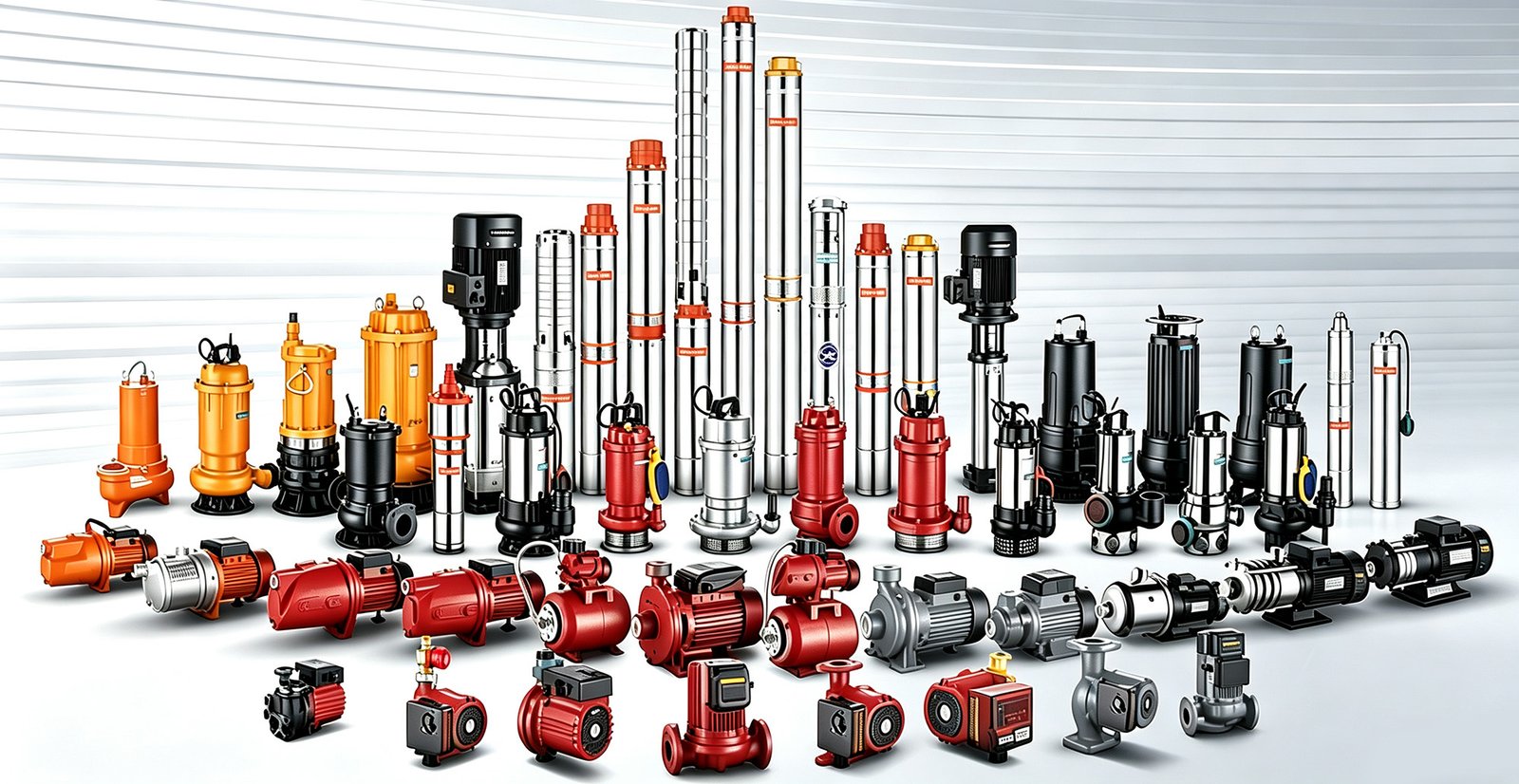
3.1 Submersible Pump (submerged in water)
- For well water, water tanks and sewage; must be fully submerged, cannot run dry.
- Types: clean‑water submersible pump, submersible sewage pump.
3.2 Self‑priming Pump (ground‑mounted)
- Placed on ground to draw water from underground wells. Maximum suction lift is generally 8‑9 m; suction lift shall not exceed 8 m, otherwise water cannot be drawn.
3.3 In‑line Booster Pump (installed on water pipeline)
- Domestic tap‑water boosting, circulation systems; connected in series in pipelines, no suction requirement, only pressurizes water.
3.4 Centrifugal Pump (industrial circulation & water supply)
- Suitable for large‑flow circulation and water supply; requires priming and air venting, cannot run dry.
4. Motor and Power Rating
Power is jointly determined by flow rate and head, higher power is not always better.
For identical head: larger flow rate requires higher power. For identical flow rate: higher head requires higher power.
- Voltage: 220 V for household use; 380 V three‑phase for large industrial pumps.
5. Pipeline Matching
- Avoid undersized pipe diameter; small pipes greatly increase resistance and reduce effective head.
- Minimize elbows and valves to lower friction loss.
- Fit a check valve at outlet to prevent back‑flow damage to the pump.
6. Practical Selection Procedure
- Define application: well‑water extraction / domestic boosting / sewage disposal / irrigation.
- Calculate required flow rate; measure vertical lifting height.
- Total head = vertical height × 1.3, reserve for losses.
- Identify medium: clean water / sewage / corrosive liquid; select corresponding material.
- Choose installation mode: submersible / self‑priming / in‑line pump.
- Verify voltage (220 V / 380 V) and select matching power rating.
Practical Example
Household well: water surface is 6 m below ground; required output 2 tons per hour, with pipe elbows. Vertical height 6 m; selected head 8‑10 m, flow rate 2 m³/h. Choose 220 V self‑priming pump or submersible pump.
If you provide:
- Application purpose (well‑water pumping? household boosting? sewage? irrigation?)
- Required hourly water output
- Vertical lifting height and approximate pipeline length
- Medium: clean water or sewage, presence of sediment